US iGaming: licensed operators vs offshore
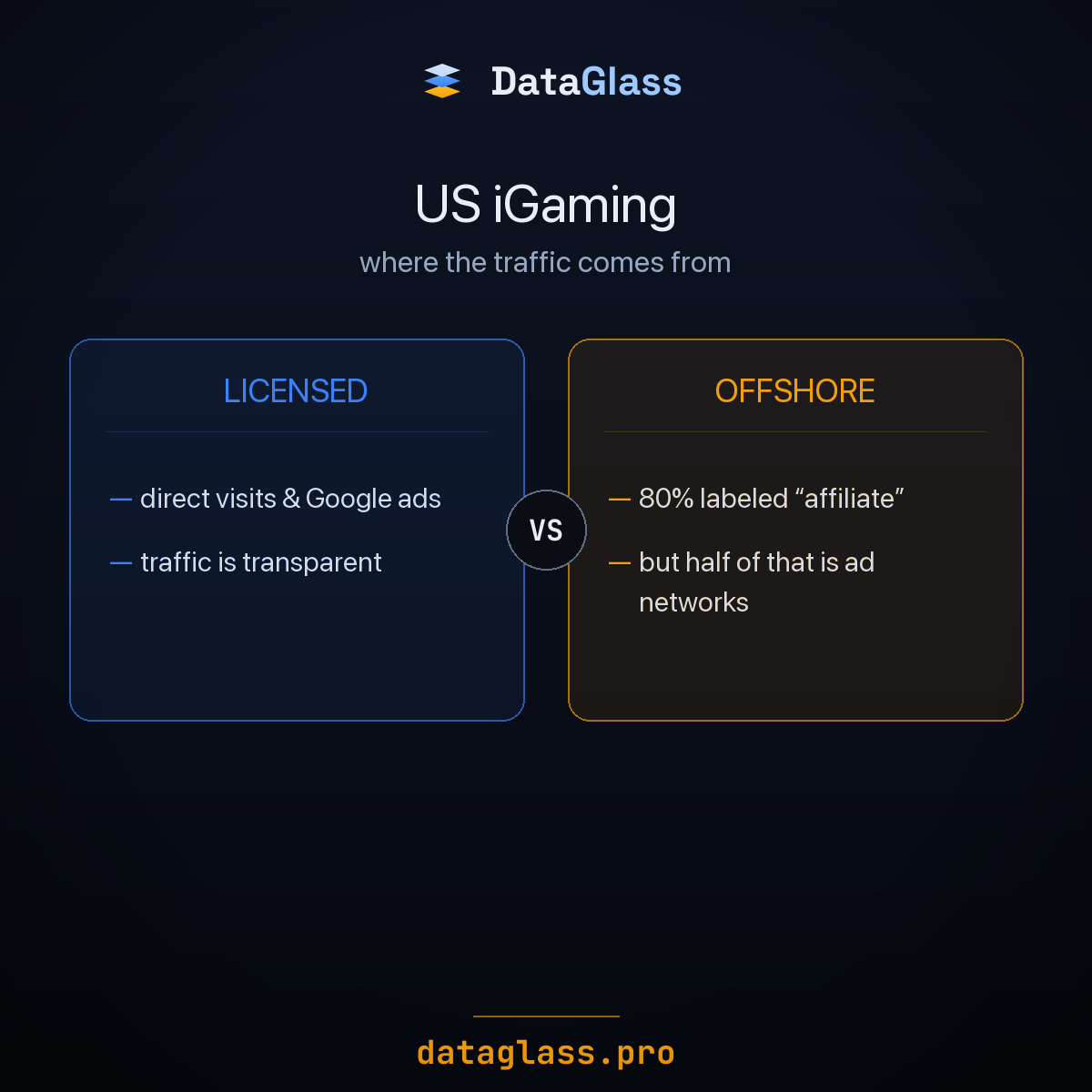
Most US iGaming traffic doesn’t go to licensed operators — it routes around them, into sweepstakes and offshore. And that’s a direct consequence of the law.
Where is online casino legal in the US?
Real-money online casino is legal in just seven states: New Jersey, Pennsylvania, Michigan, West Virginia, Connecticut, Rhode Island and Delaware. In four of the biggest — California, Texas, Florida, New York — it doesn’t exist at all. For a third of the country there’s no legal online casino, so all the demand flows around it, into sweepstakes and offshore.
Can licensed operators advertise?
In the states where it is legal, Caesars runs paid search on Google; FanDuel and BetMGM run display. The platforms are open to them. Google only lets gambling advertise with a state license — and offshore can never have one.
How offshore reaches US players
Offshore, meanwhile, goes where a licensed operator won’t: pirate sports streams. Its #1 channel there is affiliates:
- wildcasino → 80% of traffic
- betonline → 83% (25M visits a month)
Why “80% affiliate” is actually ad networks
And half of that “affiliate” isn’t affiliate at all — it’s ad networks. Adsterra, BPGame (popunder and push). Yet in analytics tools this exact traffic is tagged as partner referrals.
Is that traffic low quality? No
And the traffic isn’t junk: on bovada they stay 7 minutes; on slots.lv they view 12 pages per visit — deeper than on licensed Caesars and BetMGM.
The blind spot
Tens of millions of visits a month that neither the regulator nor analytics can see — because they’re labeled as something they’re not. A standard report shows “affiliates 80%”, and you might conclude offshore has strong partners. When in reality it’s media buying through ad networks. One label — and your conclusion about the market is wrong.
FAQ
Are offshore online casinos legal in the US?
There’s no federal law that prosecutes a player for using an offshore site — federal law targets operators and banks. Real-money online casino is licensed in only a few states, so for most of the country offshore sites are the de-facto market, under a foreign licence rather than a US regulator.
In which US states is real-money online casino legal?
As of 2026, seven states license it: New Jersey, Pennsylvania, Michigan, West Virginia, Connecticut, Rhode Island and Delaware (Maine added tribal-run online casino in 2026). The four biggest — California, Texas, Florida and New York — have not.
Why is online casino unavailable in California, Texas or Florida?
iGaming is legal only where a state passes a law authorising it. Where none exists, there’s no regulated real-money casino — so demand routes into sweepstakes and offshore.
Can licensed US operators advertise online?
Yes. Caesars runs paid search on Google; FanDuel and BetMGM run display. Google only allows gambling ads with a state licence — which offshore operators can’t obtain.
How do offshore casinos get their US traffic?
Their #1 channel is “affiliates”, largely on pirate sports-streaming sites — wildcasino ~80% of traffic, betonline ~83%. About half of that “affiliate” is actually paid ad networks (Adsterra, BPGame) via popunder and push.
Is offshore casino traffic low quality?
No — it’s often more engaged than licensed sites: bovada visitors stay ~7 minutes, slots.lv sees ~12 pages per visit, deeper than Caesars or BetMGM.
Related pages
The US is open in the free trial — take the ready-made insights and build data-driven hypotheses, on data adapted to the specifics of the iGaming market.
Start free trial